UNT, Cole Family and Johnson Development Collaborate to Preserve Native Prairie at Cole RanchJuly 28, 2026
The following is provided by the University of North Texas. DENTON (UNT), Texas — Roughly 10 minutes south of the University of North Texas campus, UNT faculty and students, the Cole family and Johnson Development are working together to preserve and reintroduce native prairie plants as plans move forward for Cole Ranch, a new 3,000-acre community. “From the beginning, this has been a shared effort to understand what makes this prairie special, protect high-quality areas and find ways for native plants to remain part of Cole Ranch’s future,” said Clinical Assistant Professor Jaime Baxter-Slye in UNT’s College of Science. “It gives our students hands-on experience while helping create a community that understands and values its native landscape.” The Cole Ranch site is situated in the Fort Worth/Grand Prairie and Plains ecoregion, a wide lowland with rolling hills. The Cole family’s careful stewardship of the ranch since the 1930s has helped maintain high-quality native prairie across portions of the property. “If I had to rate the prairie on a scale of 0 to 10, where 10 is completely intact before European settlement, it is an overall 8,” Baxter-Slye said. “I have never seen a prairie like it within DFW on a ranch. We even found one pocket that was a 10 out of 10, and the partners worked together to preserve it in place.” Early in the planning process, Cole Ranch family member Jennifer Alexander and family representative Ocie Vest invited Baxter-Slye and other professors from the College of Science to meet with Johnson Development and CCMC, a community management organization. The group began discussing how UNT’s expertise could support both near-term preservation work and long-term stewardship at Cole Ranch. “For generations, our family has understood that caring for this land means planning thoughtfully for its future,” said Jennifer. “We invited UNT and Johnson Development to work alongside us so the native prairie and the stewardship values that have guided Cole Ranch can remain part of the community for generations to come.” Baxter-Slye then developed a proposal for a team to identify, collect and temporarily care for native plants from areas where relocation is needed. Led by Baxter-Slye, the team includes four undergraduate interns and about 40 volunteers, including undergraduate and graduate students and community members who have participated in rotating workdays since September 2025. “Knowing that our work will help preserve this prairie and shape how native landscapes are integrated into the community feels great,” said Calvin Nering (’26), a recent ecology for environmental science graduate who will remain at UNT to pursue a Ph.D.
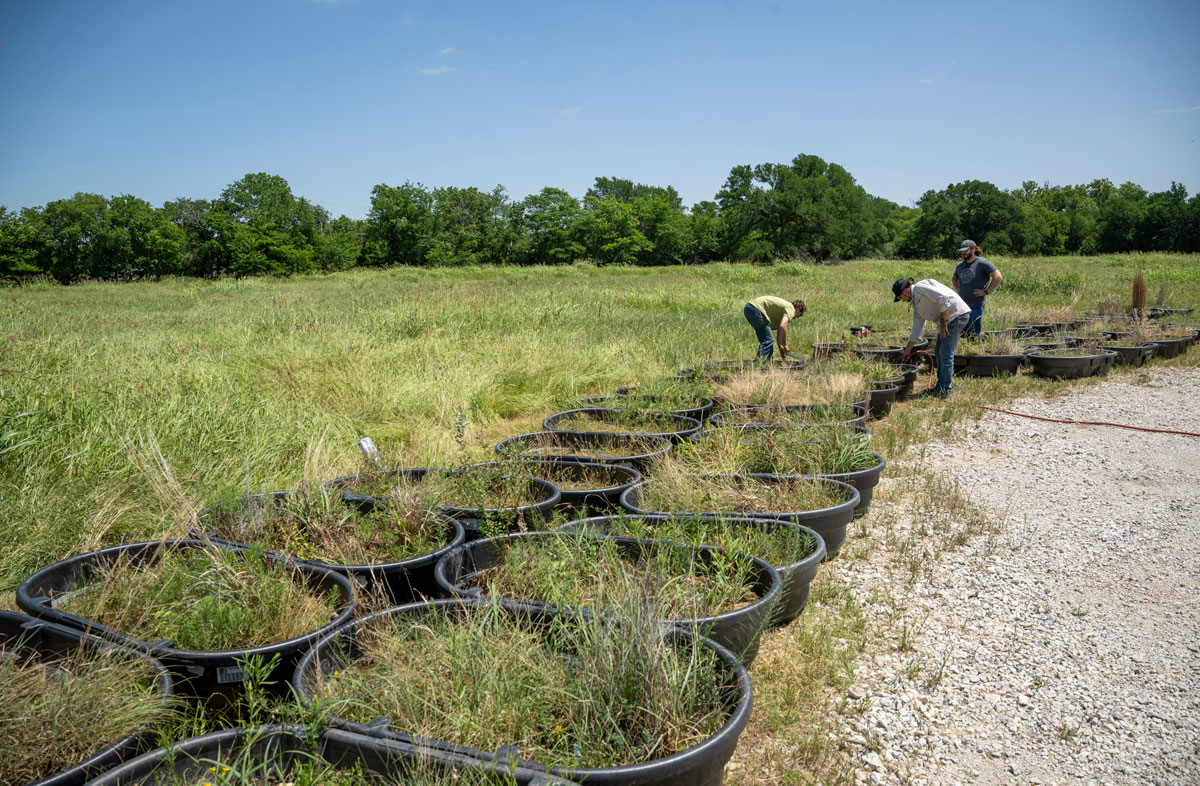
Photo courtesy of UNT On workdays, the teams arrive with trucks, 50-gallon stock tanks, pots and shovels. Some collect native soil while others carefully transplant native grasses and forbs, including flowering plants such as milkweed. They clean the roots, remove dead leaves and place the plants in temporary stock tanks until they can be reintroduced at Cole Ranch. “The reason we take the soil is because it has a lot of intact microbiota that helps plants grow,” Baxter-Slye said. “This is also the soil the plants are accustomed to, so we hope it will help them adjust to being moved and later reestablished.” As they work, the students learn how to survey the land, identify plants and develop best practices for collecting and transplanting them. They also are learning which plants adapt well to relocation and how to address challenges with species that need additional care. “It’s a lot of learning as we go, and we’re getting really good hands-on experience,” said Madalyn Chandler (’26), an intern on the team. “This is something we can take with us after our internship. For me, I hope I can continue in prairie work, too.” Thanks to their efforts, UNT recognized the group as its 2026 Employee Team of the Year. Their work will continue over the years as Cole Ranch takes shape. As parks, trails and landscaped areas are completed, the team plans to return the collected plants and native soil to the community, helping establish landscapes rooted in the site’s ecology. “Cole Ranch is being planned as a community where the land’s history and natural character remain visible,” said Tommy Tucker, Johnson Development’s Vice President of Business Development for Central and North Texas. “The Cole family’s stewardship, UNT’s expertise and the work of students and volunteers are helping us preserve significant prairie areas, reintroduce native plants throughout the community and create a foundation for ongoing education and care.” Baxter-Slye and her students also plan to work with CCMC to develop educational materials for residents and visitors. CCMC says the two will also work together to create programming for the community to cultivate pride in Texas nature. Prairie areas identified for preservation will remain in place, while trails can help people experience and understand the landscape. UNT students also will have opportunities to support ongoing habitat management and monitoring in the community. “This partnership can continue for years,” Baxter-Slye said. “Our students can return to support restoration, education and habitat management while building their own skills. It is a meaningful way to extend the Cole family’s stewardship legacy and help future residents, including children growing up at Cole Ranch, become good stewards of Texas plants and wildlife.” About the University of North Texas The University of North Texas is a Carnegie R1 public research university and the largest university in Dallas-Fort Worth — one of the most dynamic regions in the world. Through its campuses in Denton and Frisco, Texas, UNT serves nearly 44,000 students with 242 degree programs and awarded more than 13,000 degrees last year. UNT proudly serves in the vanguard of leading American universities willing to measure success by how well we educate and support every qualified student who commits to learning with us. We deliver outcomes that matter to students, families, employers, and the nation, as a public university committed to create enduring value for the public good. Photos courtesy of the University of North Texas |